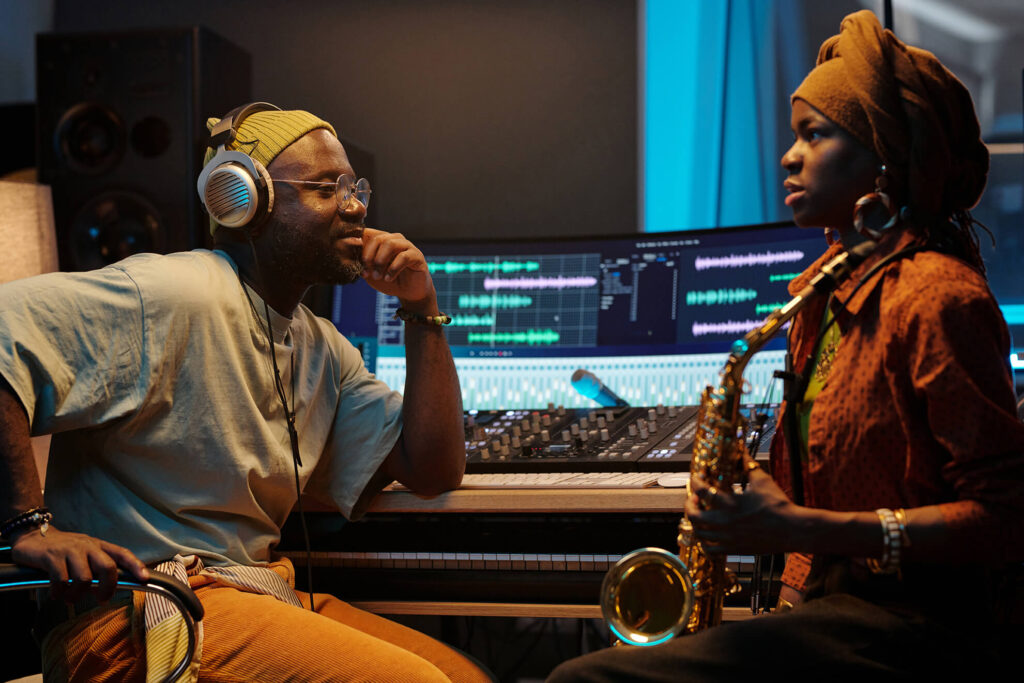
The South African Music Technology and Innovation Capacity-building (SAMTIC) project funded by the European Union (ERASMUS + Capacity Building) involving 4 South African universities and 2 European Union universities. The project addresses urgent educational, economic, and technological gaps in South Africa’s higher education system—particularly in digital music training—through internationalisation, curriculum renewal, infrastructure development, and professional upskilling.
South African higher education institutions continue to struggle with the migration to digital education in music due largely funding challenges. Reduced national funding to universities has led to deteriorating infrastructure, staff shortages, outdated curricula, and reduced programme offerings particularly in the area of music technology. Digital music education has been significantly affected: with laboratories and recording studios often outdated, obsolete, or severely understaffed. As a result, graduates lack key digital production, recording, and technology skills, leaving them disadvantaged in the global music industry and contributing to persistent skills drain.
The SAMTIC directly responds to these challenges through capacity-building between EU and SA universities. Benefits include broadening EU partnerships in Africa, while supporting South African HEIs to transition towards digital transformation. The project aligns with Erasmus+ priorities for internationalisation, digital transformation, widening access to education, and improving employability. It also supports the EU’s Digital Education Action Plan (2021–2027) and Africa-focused goals of digital innovation, sustainable growth, and human development.
The project includes five key objectives:
through in-person workshops, lectures, and practical sessions hosted by Hochschule für Musik Nürnberg (HMN) and University of Sofia St Kliments Ohridski (US). Staff are expected to improve digital competency training in the use of current music technology hardware and software and also explore current trends in digital music and artificial intelligence.
including studios and laboratories with 2025-level software, new computers, MIDI controllers, microphones, converters, and professional audio interfaces. This represents a 25–100% improvement in current capacity; TUT will establish South Africa’s first fully functional HEI-based professional recording studio for teaching and production.
including a digital music education symposium in South Africa, joint performances, and international dissemination of collaborative recordings.
across participating SA HEIs to incorporate contemporary digital music production, audio recording, AI and multimedia practices. Revised curricula will affect at least three modules per institution and include 10–25% new course content based on EU standards.
including participation in professional recording projects (CD recordings) to be distributed internationally. Staff will apply new skills in recording, production, and AI-supported platforms.